Forget the diet. Change planet.
Thinking of going on a diet? Stop right there. We have a much better idea: a way to see the number you want on your scales without giving up a single croissant.
The problem was never you, it was your planet. Earth pulls far too hard. There is one small catch: you will need a new planet. Let’s talk about it.
Order your planet
Tell us what your scales say, and what you would like them to say. We will build the planet where they do, and tell you which real world comes closest.
Your planet
Tell your friends where you are moving
What is it made of?
The same gravity can come from a small dense planet or a large light one. Choose your building material.
Daily life over there
Or pick a real destination
What your scales would read across the Solar System. The gold line is your target.
Model and reading guide
Each planet is treated as a uniform ball, so surface gravity is proportional to density times radius. That is close for rocky worlds and rougher for ice and iron, which compress under their own weight. A real rocky planet with 75% of Earth’s gravity would be a few per cent larger than shown, because its rock would be less squeezed. For the giant planets, “surface” means the cloud tops. Whether a planet keeps its air also depends on its temperature; here it is judged on gravity alone. The jump assumes you push off as hard as on Earth. Figures are rounded.
Why the number changes, but you do not
Mass is the amount of matter in you, measured in kilograms, and it is the same everywhere. Weight is the force with which a planet pulls on that mass. Bathroom scales measure the force, then display it as kilograms on the assumption that you are standing on Earth.
Take your scales to the Moon and they would show about one sixth of the usual figure. Nothing about you has changed: the scales are simply wrong about which world they are on.
The recipe for gravity
Surface gravity depends on two things: how much mass the planet has, and how far its surface is from its centre. For a ball of uniform material this boils down to something pleasantly simple: gravity is proportional to the planet’s density multiplied by its radius.
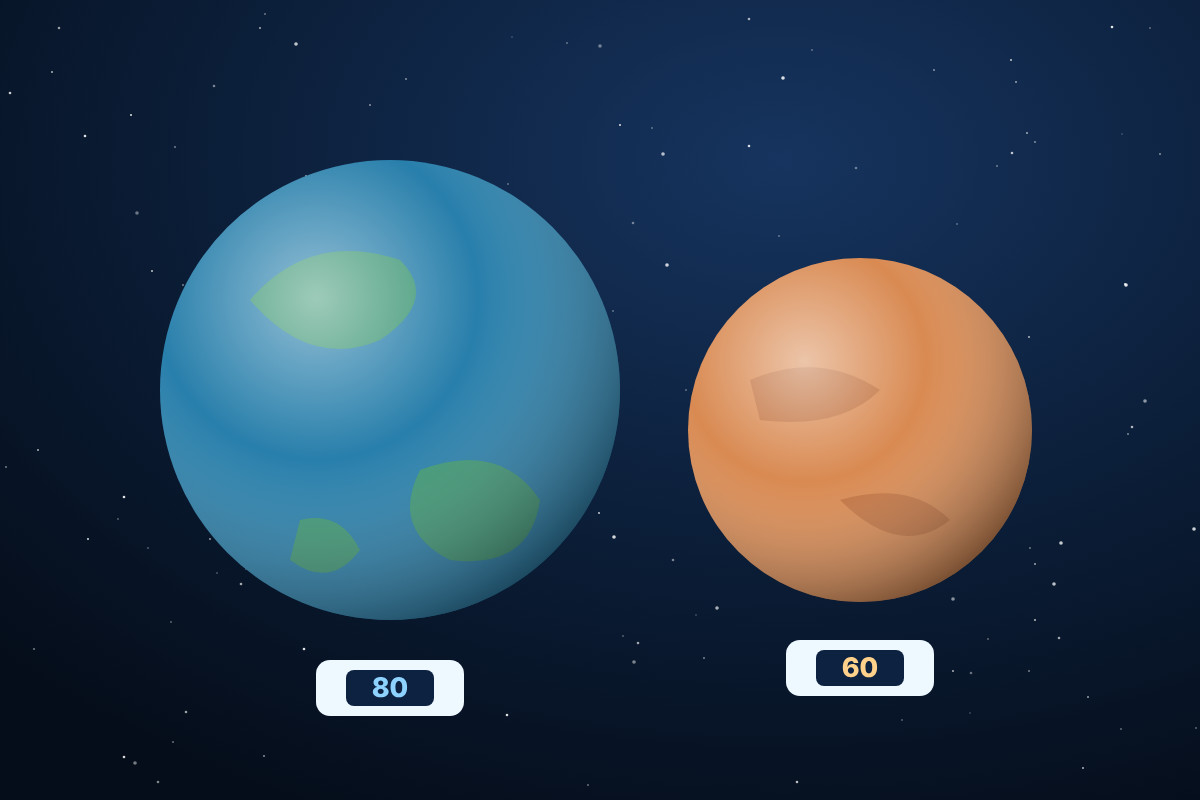
Keep Earth’s rock and shrink the radius to 75%, and gravity falls to 75%. That is the planet for someone who reads 80 on Earth and would like to read 60: about 4,780 km in radius, with 42% of Earth’s mass.
Why nothing off the shelf fits
The Solar System has an awkward gap. Mars and Mercury pull at 38% of Earth’s gravity; the next step up is Uranus at 89% and Venus at 90%. If your ideal lies between the two, no existing world will do, and you have to order one.
The giants are a surprise. Saturn has 95 times the mass of Earth, yet at its cloud tops you would weigh only about 6% more than at home. It is so large and so light for its size that the two effects nearly cancel.
The small print
A real planet is not a uniform ball. Rock and iron are squeezed by the layers above them, so a real world of a given mass is a little smaller and denser than our simple recipe says. For the sizes most people ask for, the error is modest.
There is also a limit to how big a rocky planet can grow. Studies of planets around other stars suggest that above roughly 1.6 Earth radii, most have gathered a deep layer of gas and are no longer rocky. Past that size, there is no ground to put your scales on.
The budget option: stay on Earth
Your scales already read differently around our own planet. Earth’s spin and its slightly flattened shape make gravity about 0.5% weaker at the equator than at the poles: an 80 kg reading becomes roughly 79.6 kg.
And on the International Space Station the scales read zero, although gravity there is still about 90% as strong as on the ground. Astronauts are not beyond gravity. They are falling around the Earth, and so are the scales.
Sources and method
Surface gravities come from NASA’s planetary fact sheets. Made-to-measure planets are calculated in your browser from the uniform-sphere relation between gravity, density and radius; nothing you type is sent anywhere.
Comments