How do you weigh a star?
You cannot put a star on a scale. But if it has a companion, you can watch their dance. Move the controls and discover how motion reveals mass.
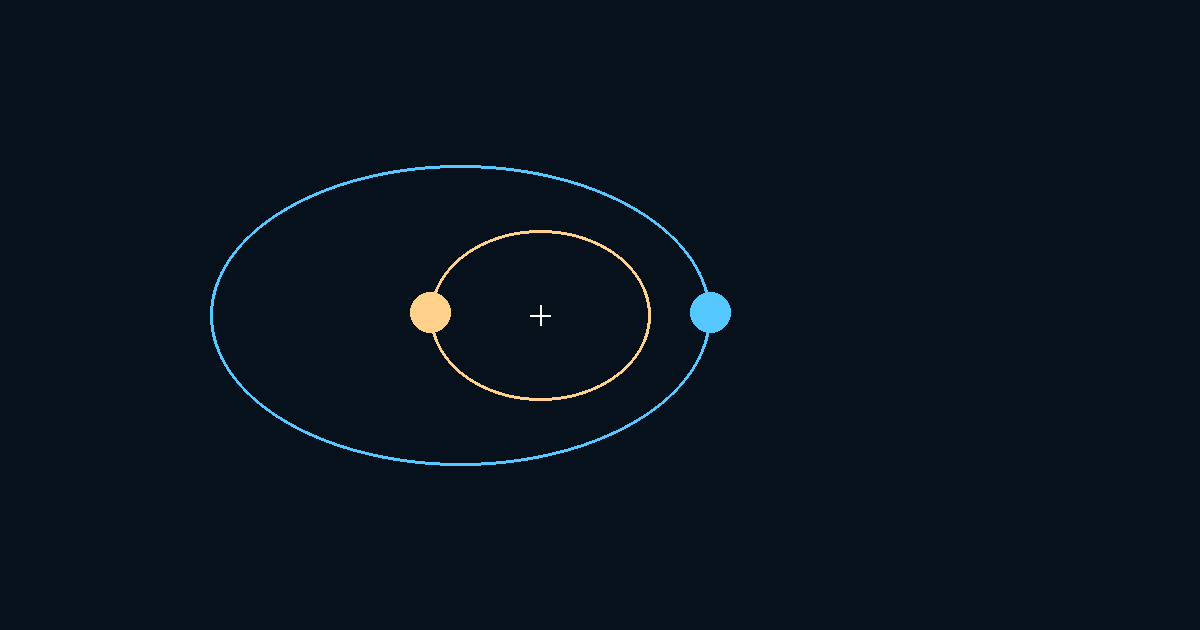
Watch the stellar dance
Start with two equal masses. Both stars travel around the cross at the centre. Now make star A heavier: it moves less, while its lighter companion traces a wider orbit. The cross is the centre of mass, not a third object.
Circular orbit model. Masses are independent of the illustrated colours and disc sizes. One astronomical unit (AU) is approximately the Earth–Sun distance. Animation speed is accelerated; the displayed period is the physical one.
A scale made of gravity
Gravity supplies the inward acceleration that keeps each star in orbit. A tight pair can circle quickly, while a wider pair takes longer. At a fixed separation, adding mass makes gravity stronger and the orbit faster. This is why a period by itself cannot tell you the mass: you also need the size of the orbit.
Try this: double both masses while keeping the separation fixed. The period falls by a factor of √2. Then double the separation: the period grows by a factor of √8.
The equation behind the dance
When a is the semi-major axis of the relative orbit in AU and P is the period in years, the combined mass in solar masses is Mₐ + Mᵦ = a³ / P². For our circular model, a is the constant distance between the stars. For an elliptical orbit, it is half the sum of the closest and farthest separations.
This is Newton’s version of Kepler’s third law. It weighs the whole system first. The Sun is the unit of mass, so a result of 3 means three solar masses, not three kilograms.
Which star is heavier?
Both stars complete an orbit in the same time, but they need not travel the same distance. Their distances from the centre of mass satisfy Mₐrₐ = Mᵦrᵦ. The star with the smaller orbit is the heavier one. If A travels half as far as B, A has twice B’s mass.
A very faint companion can still betray its presence through the brighter star’s motion. Astronomers also use changes in spectral lines to measure motion towards and away from us.
The sky gives us a projection
Tilt the orbit towards 90 degrees. Its apparent shape flattens until it looks like a line, even though the stars still move in a circle. Measuring that flattened picture as if it were the full orbit would give the wrong answer.
A real measurement needs distance to convert angular separation into AU, and a fitted orbit to account for viewing geometry. Spectroscopic systems have their own inclination ambiguity. Our sliders supply the true physical separation, so the mass result does not change when you tilt the view.
Could you do this from your garden?
You can observe some double stars through a telescope, but a useful orbital mass usually needs measurements spanning years or decades, a known distance and careful calibration. A pretty photograph alone cannot weigh a star.
The simulation makes the experiment immediate. For a real project, compare published positions over time or investigate a well-studied binary using archive measurements. Single stars require other methods, often relying more heavily on stellar models.
Weigh a mystery pair
This fictional binary has a true relative semi-major axis of 4 AU and a period of 4 years. Star A’s orbit around the centre of mass is one third the radius of star B’s. Find the combined mass, then the mass of A.
Sources and method
All animations and challenge measurements are simulated for teaching.
Comments