Can you discover a hidden planet?
The planet is lost in its star’s glare. But when it passes in front, the starlight gives it away. Can you read the dip and uncover an unseen world?
Make a planet leave its signature
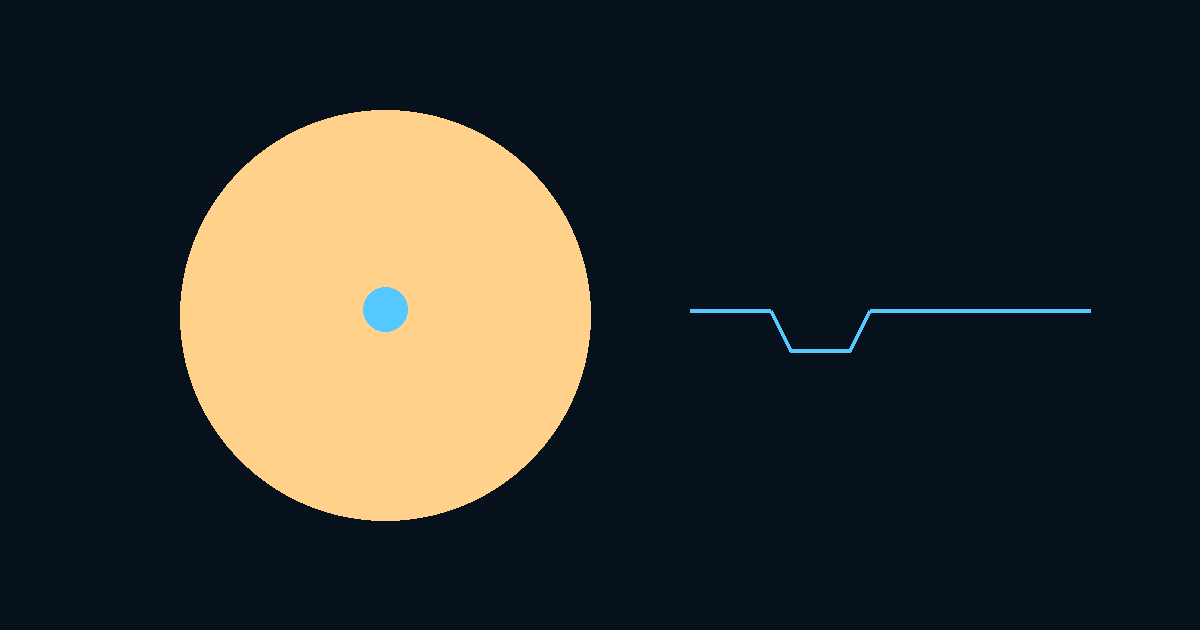
The orange disc is a Sun-sized star. The blue planet is shown at its true size relative to that disc. The graph zooms in on one transit and draws the brightness curve as the planet moves. The gold dot shows the same instant in both views. Change the planet size, orbital period and inclination, then add noise to see how a clean signature becomes harder to recognise.
Simulated measurements, not telescope data. Circular orbit around a star with the Sun’s mass and radius; uniform stellar brightness. The planet’s light is ignored. Inclination 90° is edge-on. Noise is a repeatable illustrative perturbation, not an instrument error model. The axes stay fixed for comparison: −6 to +6 hours from mid-transit, and 97.8% to 100.2% relative brightness. Small planets therefore make genuinely smaller dips; changing the period changes the transit width. The horizontal axis shows hours from mid-transit; playback is accelerated and loops. Pause or drag the animation position to inspect ingress and egress.
A miniature eclipse
A transit happens only when the planet passes between us and its star. Most orbital orientations never produce one. Turn the inclination down from 90 degrees and the planet’s path moves towards the stellar edge, then misses the disc entirely. An absent dip does not mean an absent planet.
The animation shows the planet near conjunction, when it could cross the star. Its depth along our line of sight is not visible. A planet passing behind the star does not block its light, so there is no second transit dip.
A shadow that measures size
For a small planet fully in front of a uniformly bright star, the fractional loss of light is approximately δ = (Rₚ / R★)². Twice the planet radius means four times the depth. To recover a radius, use Rₚ = R★√δ. You must know the stellar radius.
For a Sun-sized star, an Earth-sized planet blocks about 84 parts per million of its light: only 0.0084%. The percentage is small because the planet covers a tiny fraction of the star’s area.
A clock in the starlight
Measure the time from one transit to the next. That interval is the orbital period. With the star’s mass, Kepler’s law also gives an estimate of the orbital size. Our period control changes that size consistently rather than simply speeding up an arbitrary drawing.
Shorter periods produce closer orbits. Longer periods make alignment less forgiving, because the star subtends a smaller angle from the planet. Try changing the period while the inclination is just below 90 degrees.
Why real discoveries take care
The bottom of a real light curve is not always flat. Stars are dimmer near their edges, an effect called limb darkening; spots and stellar variability alter brightness too. Grazing transits cover only part of the planet’s disc and do not follow the simple full-transit depth formula.
Our model computes the overlap of the two discs but omits limb darkening. Measurement noise can hide small dips. Repeated observations help, yet an eclipsing binary or a blended background star can imitate a planet. A repeating dip is a candidate signal, not proof on its own.
Turn a graph into an investigation
The challenge below uses a fictional, clean, central transit around a Sun-sized star. Estimate its period and radius from the supplied measurements. Then return to the simulator and see whether you can reproduce the depth.
For a later observing project, published light curves let you practise on real data without owning a telescope. Measuring a transit yourself needs stable photometry, comparison stars and a suitable target. This article does not assume that every small telescope can detect an Earth-sized planet.
Find the mystery planet
In this fictional light curve, central transits occur at days 1, 6 and 11. Each drops the brightness by 1.00%. The star has the Sun’s radius, approximately 109.1 Earth radii. What is the orbital period, and what is the planet’s radius in Earth radii?
Sources and method
All animations and challenge measurements are simulated for teaching.
Comments