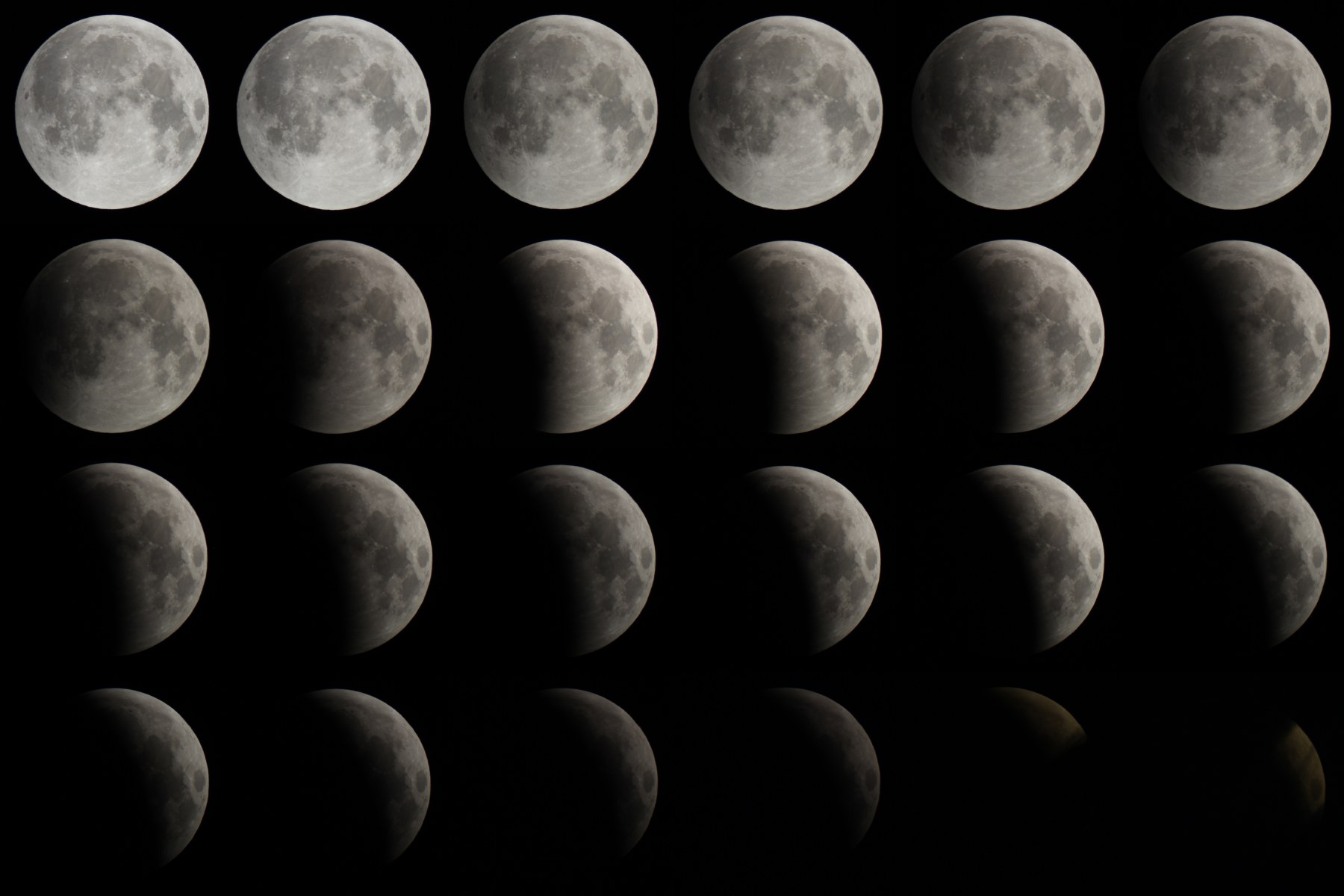
There is a slight irony in writing about an astronomical event I didn't actually see.
On 12 August, I travelled to Cornwall specifically to photograph the solar eclipse. I planned the observation, set up the Seestar S50, watched the weather and followed the Moon as it slowly moved across the face of the Sun.
Sixteen days later, the geometry reversed.
This time, Earth moved between the Sun and the Moon, and during the early hours of 28 August 2026 our planet's shadow swept across the lunar surface.
And I missed it.
But that doesn't make the eclipse any less interesting — because the two August eclipses are actually part of the same astronomical story.
Two eclipses, one alignment
A solar eclipse happens when the Moon passes between Earth and the Sun. A lunar eclipse happens when Earth passes between the Sun and the Moon.
Those sound like two different events, but geometrically they are closely related. Eclipses occur during eclipse seasons, when the orientation of the Moon's orbit allows the Sun, Earth and Moon to line up closely enough for the shadows to fall in the right place.
Solar eclipse
Sun → Moon → Earth. The Moon's shadow crossed Earth.
Lunar eclipse
Sun → Earth → Moon. Earth's shadow crossed the Moon.
That is why the lunar eclipse happened just over two weeks after the 12 August solar eclipse. It's a rather beautiful symmetry.
Almost — but not quite — total
The 28 August eclipse was officially a partial lunar eclipse. But “partial” slightly undersells what happened.
NASA lists an umbral magnitude of 0.930, meaning Earth's umbra extended across about 93% of the Moon's diameter at maximum eclipse. Only a thin portion of the lunar disc remained outside the darkest part of Earth's shadow.
Had the Moon travelled just a little deeper through Earth's shadow, this would have been a total lunar eclipse.
From the UK
For observers in Britain, it was an early start. The Royal Observatory Greenwich gives the following timings in British Summer Time:
The Moon was becoming very low in the sky as maximum approached, so a clear south-western to western horizon was important. From London, for example, the Moon set at around 06:15, before the formal end of the partial phase.
Why did the Moon turn red?
Earth's shadow isn't simply black.
During a lunar eclipse, some sunlight passes through Earth's atmosphere before reaching the Moon. Shorter blue wavelengths are scattered more efficiently, while redder wavelengths are refracted into Earth's shadow.
In effect, the eclipsed part of the Moon is illuminated by sunlight that has skimmed through the atmosphere around the edge of Earth. That produces the familiar copper, orange or reddish appearance associated with lunar eclipses.
This is also where the popular expression “Blood Moon” comes from, although it isn't a formal astronomical term.
Why don't we get eclipses every month?
If the Moon orbits Earth every month, why doesn't every New Moon produce a solar eclipse and every Full Moon produce a lunar eclipse?
Because the Moon's orbit is tilted by about 5° relative to Earth's orbit around the Sun. Most months, the Moon passes slightly above or below the alignment required for an eclipse.
Only when a New or Full Moon occurs close to one of the two points where the Moon's orbit crosses Earth's orbital plane — its nodes — can an eclipse occur.
Sometimes astronomy happens without you
One of the things I like about astronomy is that the sky doesn't care whether you're watching.
Clouds arrive. You sleep through an alarm. The object disappears behind a building. Or sometimes life simply gets in the way.
I didn't see the lunar eclipse on 28 August. But sixteen days earlier I had watched the other half of the same celestial alignment from Cornwall.
And understanding the connection between those two events is, for me, almost as interesting as photographing them.
The next time you see a solar eclipse, therefore, have a look at the calendar roughly two weeks before and after it.
There may well be another shadow waiting.
The other half of the August eclipse pair
On 12 August I did get to observe the solar eclipse from Cornwall. Read the full observing story and see how the event was recorded with the Seestar S50.
Read the solar eclipse article →Astronomical timings and eclipse magnitude checked against the Royal Observatory Greenwich and NASA's lunar eclipse catalogue.
Comments