Watching the Sun Disappear
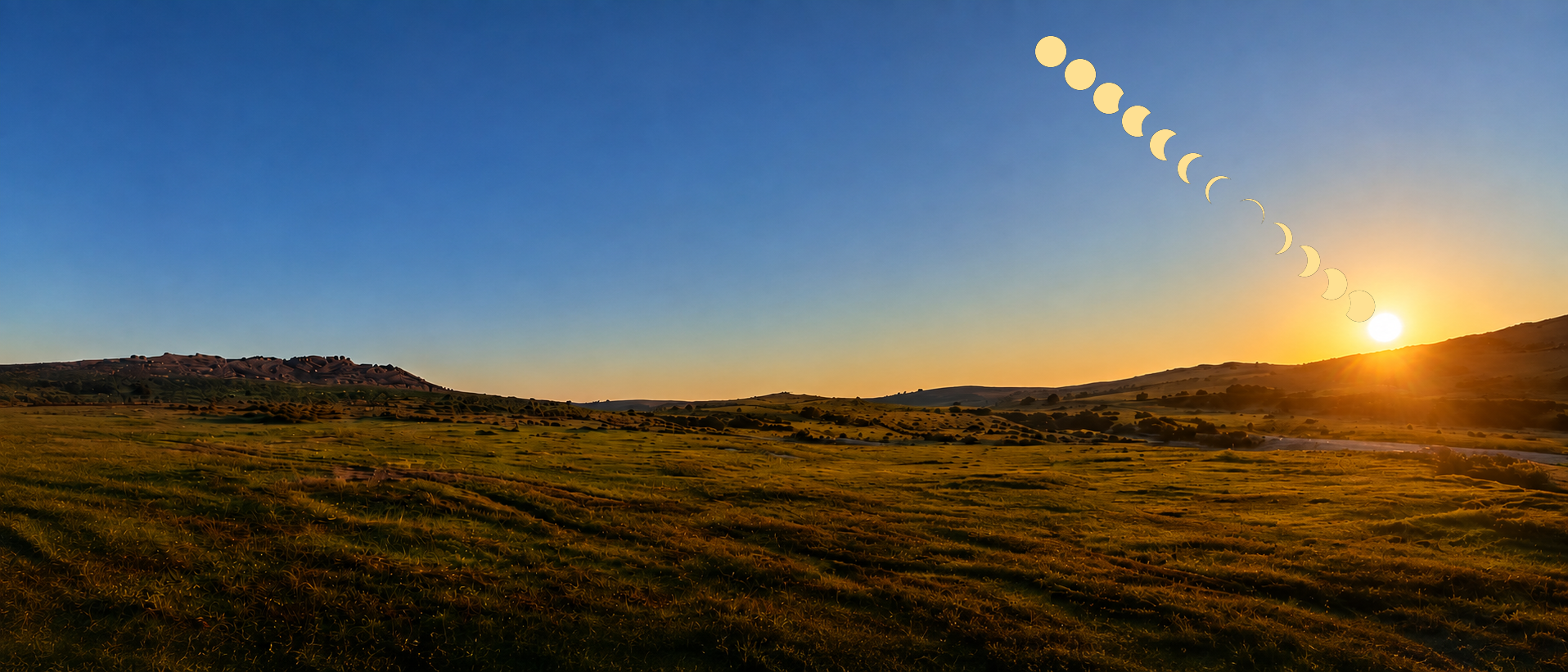
On 12 August 2026, the Moon passed directly in front of the Sun. From North Hill in Cornwall it was not a total eclipse, but at maximum the Moon covered roughly 95% of the Sun — leaving only a brilliant curved sliver visible low above the western horizon.
A rare evening eclipse
Solar eclipses happen because of an extraordinary coincidence. The Sun is about 400 times larger than the Moon, but it is also roughly 400 times farther away. As a result, the two objects appear almost the same size in our sky.
When the Moon passes between the Earth and the Sun, its apparent disc can therefore cover part — or occasionally all — of the Sun. The exact view depends on where you are standing on Earth.
On 12 August 2026, the path of totality crossed parts of the Arctic, Greenland, Iceland and northern Spain. Cornwall lay outside that narrow path, so from North Hill the event appeared as a very deep partial solar eclipse.
Observing from North Hill
I observed the eclipse from near Trewortha Farm in North Hill, Cornwall. The location mattered because this was an evening event: as the eclipse progressed, the Sun moved steadily towards the western horizon.
The challenge was therefore not simply to photograph the eclipse. I also needed an observing position with a sufficiently clear view towards the west so that hills, trees or buildings would not hide the Sun before the event was over.
Why Cornwall was interesting
Although Cornwall was outside the path of totality, the Moon still covered most of the Sun. The result was a striking crescent-shaped solar disc during the deepest part of the eclipse.
Why the horizon mattered
Maximum eclipse occurred with the Sun already quite low in the sky. That made the surrounding landscape part of the observation and created the possibility of photographing the eclipsed Sun close to the horizon.
The eclipse unfolds
A solar eclipse is not an instantaneous event. The Moon moves slowly across the apparent face of the Sun, so the geometry changes continuously over nearly two hours.
First contact. The edge of the Moon begins to move onto the solar disc. At first the small indentation can be surprisingly difficult to notice.
Maximum eclipse from North Hill. Around 95% of the Sun is covered by the Moon, leaving a thin, brilliant crescent of sunlight.
End of the eclipse. The Moon finally leaves the solar disc as the Sun approaches the western horizon.
These times are local British Summer Time and vary slightly with the observer's precise location.
Recording the eclipse with a Seestar S50
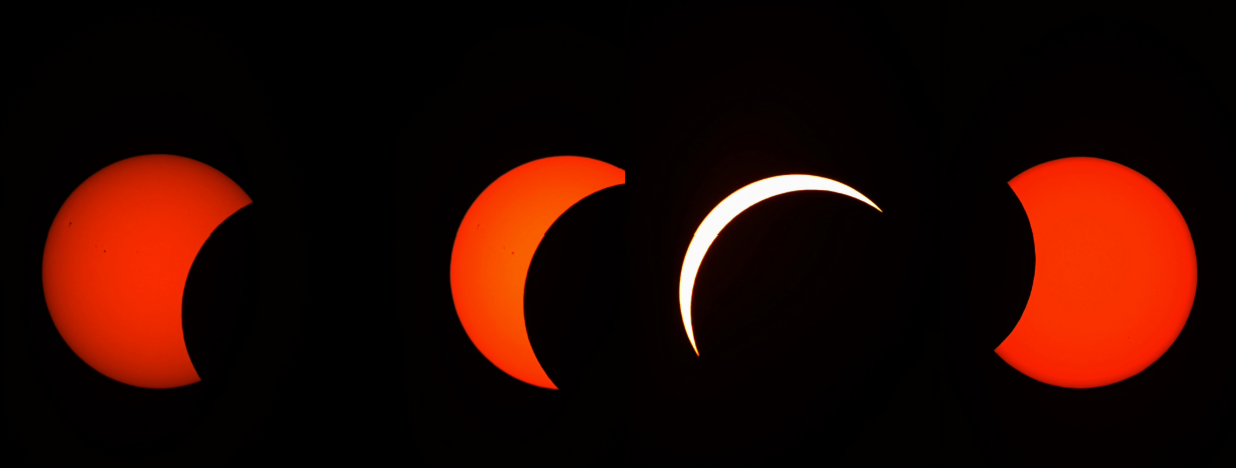
Rather than taking only a single photograph, I used a Seestar S50 equipped for solar observing to record the event as a timelapse.
This is particularly useful for an eclipse because a sequence reveals something that an individual photograph cannot: the motion of the Moon relative to the Sun.
One image
A single exposure records the shape of the eclipse at one particular instant. It shows how much of the Sun was covered, but not how the event developed.
A timelapse
A sequence of images transforms the observation into a record of orbital motion. Frame by frame, the dark lunar disc moves across the Sun and eventually leaves it again.
From photographs to celestial mechanics
One of the things I find most interesting about an eclipse is that the photographs are more than attractive images. They are a direct record of the geometry of the Solar System.
At every instant, the appearance of the eclipse is determined by the relative positions of the observer, Earth, Moon and Sun. If those positions are calculated accurately, we can predict where the Moon should appear on the solar disc at any particular time.
That means the observed images can be compared with a theoretical eclipse model. The progression of the Moon across the Sun becomes a simple visual demonstration of celestial mechanics.
The apparent motion
The Sun itself moves across our sky because the Earth rotates. At the same time, the Moon is travelling eastwards in its orbit around Earth. The eclipse is produced by the combination of these motions and our particular observing position.
Why location changes the eclipse
Move the observer to another part of Earth and the alignment changes. Some observers saw a smaller partial eclipse, while those positioned inside the narrow path of the Moon's umbral shadow experienced totality.
Why wasn't it total in Cornwall?
The Moon casts a shadow into space. The darkest central part of that shadow is called the umbra.
Only observers located where that narrow shadow intersects the Earth see the Moon completely cover the Sun. That region forms the path of totality.
North Hill was outside that path. We were instead inside the much larger region reached by the Moon's penumbra. From there the Moon and Sun were not perfectly aligned, so a small part of the solar surface remained visible even at maximum eclipse.
The changing light
A deep partial eclipse can also change the character of the landscape. As the visible area of the Sun becomes smaller, the illumination gradually falls and the quality of the light can become unusual.
But there is an important difference between a deep partial eclipse and totality. Even a very small uncovered portion of the Sun's photosphere remains dazzlingly bright.
This is why a 95% partial eclipse should not be thought of as "almost safe" to look at. It is still the Sun.
Observing the Sun safely
Never look directly at the Sun through a telescope, binoculars, camera optical viewfinder or with the unaided eye unless you are using equipment specifically designed and certified for safe solar observation.
For the Seestar S50 observation, the proper solar filter must be securely fitted before pointing the telescope towards the Sun.
For visual observing, use genuine eclipse glasses complying with the appropriate solar-viewing safety standard. Ordinary sunglasses, photographic filters, smoked glass and improvised materials are not safe substitutes.
Why record an eclipse?
For me, this is where astronomy becomes especially rewarding. You can begin with something spectacular — watching the Sun slowly turn into a crescent — and then use the same observations to explore the physics and geometry behind it.
A timelapse lets us follow the relative motion of the Moon. The timestamps allow us to compare observations with predictions. The position of the Sun connects the event to our location on Earth. And the shape of the eclipse tells us where we were relative to the Moon's shadow.
In other words, the photograph becomes data.
That is the idea behind the Astronomy Lab: not simply to photograph the sky, but to see what we can measure, test and understand from our own observations.
Observe the Sun for yourself
The Sun is a dynamic star that can be explored safely with the right equipment. In a Show Me The Sky solar masterclass we can look at solar observing, sunspots, the Sun's rotation and the geometry behind events such as eclipses.
Comments