SAME STARS • ANOTHER SKY
Would you recognise the sky from another star?
Alan Vigner · Published 15 September 2026 · Updated 15 September 2026
The stars stay in place. You move. Travel to a nearby star and watch familiar patterns change shape — then look back for our Sun.
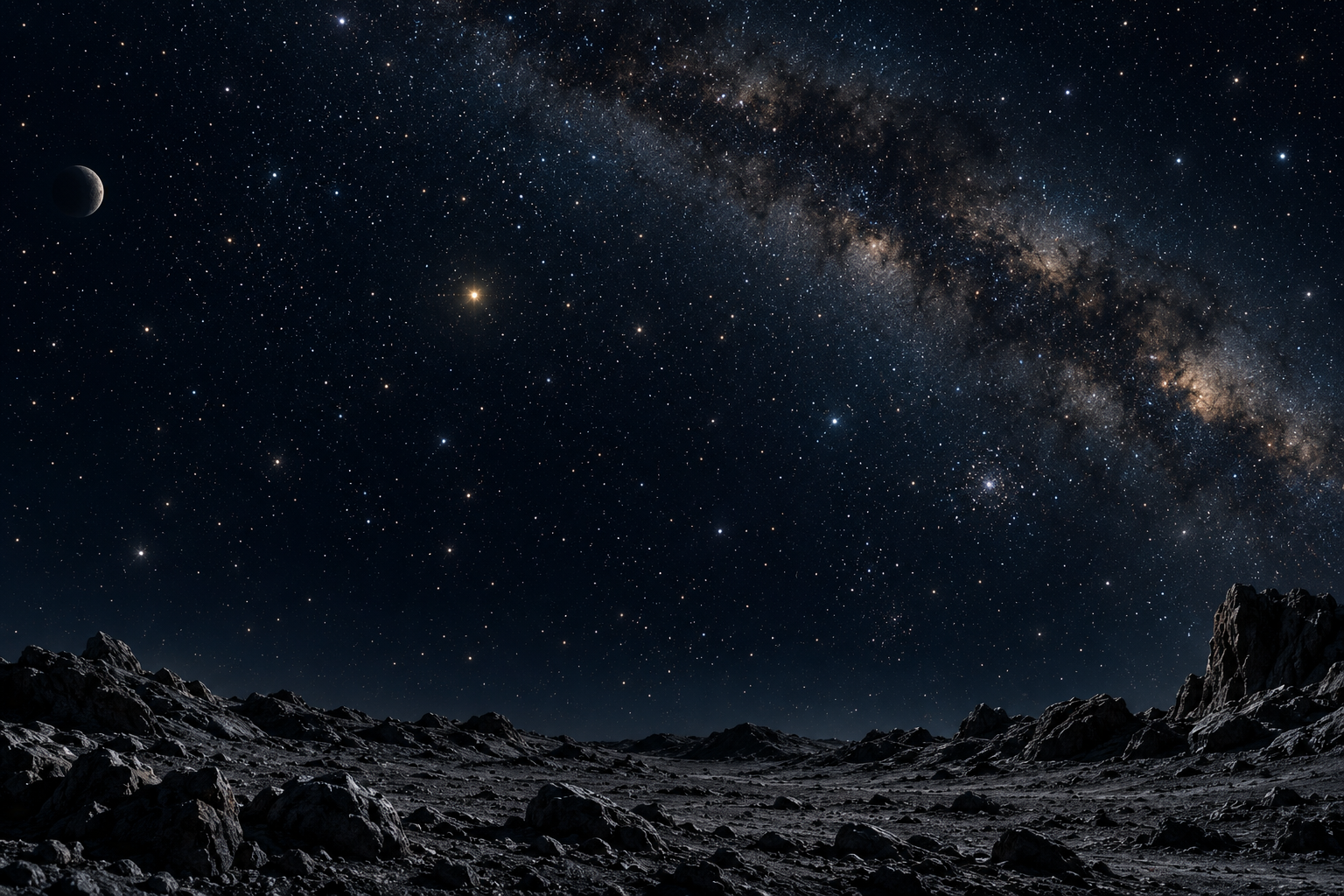
Artist’s impression of a sky seen from another world, not a calculated view from a specific star.
The sky is not a flat picture
From the ground, the stars seem pinned to one vast dome. We connect a few of them into a hunter, a queen or a familiar saucepan. But the lines are ours: the stars sit at very different distances. Two neighbours in the sky can be far apart in space.
Try holding up one finger and closing each eye in turn. Your finger appears to jump against the background. Moving to another star changes your viewpoint on a much larger scale. Nearby stars tend to shift more than distant ones, although the direction of your journey matters too.
What changes the pattern
The stars occupy three-dimensional space. Changing the observer’s position changes the direction of each star in the sky. We keep the reference lines attached to the same stars so you can follow the transformation.
What changes the brightness
A star appears brighter when you approach it and fainter when you move away. The tool recalculates apparent magnitude from the new distance. It illustrates a change of viewpoint, not a realistic spacecraft journey.
YOUR WINDOW ON ANOTHER SKY
Leave Earth. Keep the stars.
Loading the stellar catalogue…
Both views share orientation and zoom. Drag either map to look around; use + / −, Ctrl + wheel or pinch to zoom. Keyboard: arrows, + / −, 0 for the whole sky. On mobile, scroll outside the maps.
Gold: stars in the chosen pattern. Cyan ring: selected star. The Sun is labelled when it is above the chosen brightness threshold. Reference lines stay visible even when a member is too faint to plot.
Three things to try
- Choose the Big Dipper and Vega. Move the journey slider between Earth and the destination. Which part of the saucepan changes most?
- Switch to Orion and Alpha Centauri. Its distant stars may look surprisingly familiar over such a short interstellar journey. A small change is a result too.
- Press “Find the Sun”. Our daytime star becomes one point among the others. Select it to read its distance and apparent magnitude.
A worked example: the Big Dipper from Vega
Choose Vega and the Big Dipper, then compare Dubhe and Merak, the two stars along the outer edge of its bowl. In our catalogue, Dubhe is about 122.9 light-years from Earth and Merak about 79.7 light-years away. From Vega, their distances become approximately 115.0 and 74.8 light-years.
Keeping the map axes fixed, Dubhe’s direction shifts by about 11.5°, while Merak’s shifts by about 18.3°. The nearer star shifts more in this example. The stars move by different amounts and in different directions across the sky, so the familiar pattern changes shape. These are approximate results from our stationary-star model, not predictions of a future sky.
Why do the stars change brightness?
A star does not need to change its own light output to look brighter. Bring the observer closer and more of that light reaches them. In this model, halving the distance makes a star four times brighter, an improvement of about 1.5 magnitudes. Smaller magnitude numbers mean brighter stars.
The maps recalculate both direction and apparent magnitude from the new observer position. Dot sizes are illustrative; they do not represent the angular sizes of stellar discs. The chosen destination star is omitted exactly at arrival, where a point-source calculation would otherwise divide by zero.
Are constellations real?
The stars are real. The familiar stick figures depend on our viewpoint and cultural traditions. Some stars in a pattern really are associated; many are not. The Big Dipper is an asterism within Ursa Major, rather than an entire constellation. Here we keep three familiar line patterns attached to the same physical stars as you move. We do not redraw official constellation boundaries for another planet.
A change of viewpoint, not a forecast
This is a geometric thought experiment with stationary stars, not a realistic spacecraft journey. The slider gives a fraction of the distance to your destination, not years of travel. We ignore stellar motion, light-travel delays, relativity, extinction, planetary horizons and the glare of a local sun. “Near a star” means an idealised point at its catalogue position, not the surface of a known habitable planet.
The flat maps use an equirectangular projection with shared J2000 axes; shapes stretch near the poles. Comparing the same framed region is more useful than judging the shape of a full-sky map. Earth is approximated by the Sun’s position.
Catalogue and sources
The tool uses 42,738 entries with finite positive distances from HYG v4.1: stars of Earth magnitude ≤8, entries within 30 parsecs, and the selected pattern and destination stars. It is not a complete census. Catalogue distances, particularly for distant stars, can be uncertain; binary components may appear separately. The Sun uses absolute visual magnitude 4.83.
HYG — David Nash / Astronomy Nexus · CC BY-SA 4.0 · HYG README · Adapted catalogue (JSON)
For another way to explore the same idea, see ESA — Stellar Distances.
Our sky is one view of the Universe. It is not the only one.
Comments